Hi, welcome back. Here we go. In today’s blog we’re going to start the journey by walking through the article I referenced in the previous post – “WTF is a Quantum Computer?“. Why this one??? Mainly because I find the title hilariously appropriate. The purpose of the walkthrough is to create a simple list of common terms and ideas in quantum computing – a baseline, if you will. Once again, most of us are not PhD’s in quantum physics, so it’s important 1.) to create an inventory of basic terms/concepts and, probably more important, 2.) to create a list of new questions to answer.
Here we go, in real-time thought….
“Explain…in 1,000 words”
Wow…that will be impressive.
I doubt that you’re afraid to ask, no one knows what a quantum computer is. However, it’s great you made this meme. I like the article already.
two important states of matter known as superposition and entanglement
Got my first two – superposition and entanglement.
Quantum computers do not use transistors (or classical bits), instead they use Qubits.
Next one – Qubit. Note it’s ‘Qubit’, not ‘Qbit’. People keep asking me which it is.
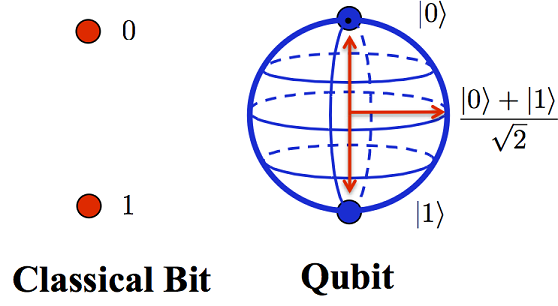
Qubits are the basic unit of information in a quantum computer.
That’s an excellent picture. Yep, that’s how I envision a classical bit. I didn’t know how to envision a Qubit, but that looks like the bit could be anywhere on the sphere (orbiting), or maybe just on the red line….0,1 or in between. Wait, those are 0’s and 1’s, those have some funky | and > and square root symbols…what do those mean?
Qubits can be either a -1 or a 1, or have properties of both of these values, which is called superposition.
Wait, what happened to 0 or a 1, that’s not what the picture shows. “Both” sounds confusing, but that’s ok. We’re talking about quantum computing, so there’s going to be possible things that aren’t supposed to be possible. Superposition…check.
Right away there’s a whole lot more possibilities for performing computations.
I don’t understand why yet, but that’s what everyone seems to think.
the Qubit can leverage a state known as quantum entanglement, whereby pairs or groups of quantum particles are linked so that each particle cannot be described independently of the others, even when the particles are separated by a large distance; opposite ends of the universe for example. Einstein called this “spooky action at a distance” and it’s the theoretical basis for quantum teleportation.
And…woah. Lemme read that again. Ok, still a mouthfull. Can I get a picture of that??
At this point you may be wondering, what’s really in that pipe, Albert?
Yes, that’s exactly what I’m thinking. Excellent…pictures coming…
What matters (to those of us who aren’t quantum physicists) is that thanks to Qubits and the phenomena of superposition and entanglement, a quantum computer can process an immense amount of computations simultaneously, and much faster than a classical computer.
That’s funny, but not the picture I was thinking of. Now I’m getting that feeling that I still don’t understand how a quantum computer works.
2. What are the practical applications of this stuff?
Wait, go back, tell me more about quantum entanglement!
a thought experiment. Imagine a phone book, and then imagine you have a specific number to look up in that phone book. A classical computer that uses transistors will search each line of the phone book, until it finds and returns the match. A quantum computer, because it has Qubits, can search the entire phone book instantaneously, by assessing each line simultaneously and returning the result much faster than a classical computer.
How?
These massive variable problems are often called optimization problems. For example, optimizing every airline route, airport schedule, weather data, fuel costs, and passenger information,
New term…bookmark it.
Classical computers would take thousands of years to compute the optimum solution to that problem. Quantum computers, theoretically, can do it in a few hours, or less as the number of Qubits per quantum computer goes up, which is already happening …
How?
That’s a great chart. D-wave seems like the only vendor quantum computer vendor shown, did they write this article??
Steve Jurveston, managing director of the investment firm Draper Fisher Jurvetson, and an early investor in D-Wave Systems, the company widely regarded as a quantum computing pioneer and standard bearer, dubbed the phenomenon of the increasing capacity of quantum computers as “Rose’s Law.” (Geordie Rose, is the CTO of D-Wave, so it’s named after him.)
I get it, like “Moore’s Law” for transistor-based CPU’s. Ok, I should probably note D-Wave Systems and “Rose’s Law.” That’s pretty bold of D-wave to take the name, we’ll see if that holds.
Rose’s Law for quantum computing parallels Moore’s Law for semiconductor processor development. Basically, quantum computers are already getting really, really fast.
Yep, I get the analogy.
D-Wave sells and leases quantum computers to clients such as Google. The machines are rumored to cost between $10M and $15M, so start saving.”
No idea what Google is using it for, but hardly shocked to see their name or ability to spend that kinda cash.
Oh, and the latest generation D-Wave 2X system has an operating temperature of about 15 millikelvin, which is approximately 180 times colder than interstellar space.
That’s cold, got it.
If a D-Wave machine isn’t in the cards, IBM is already offering “the world’s first quantum computing platform delivered via the IBM Cloud,” meant to unleash quantum processing power to the masses
IBM also in the picture.
Modern cryptography (secret codes) relies on a mathematical function called prime number factorization. Basically, large numbers are broken down into prime numbers that can then be multiplied together to get the large number. Classical computers are not good at this and take a long time to crack cryptographic codes based on prime number factors. But, you guessed it, quantum computers are really, really good at it.
That’s interesting. How does a quantum computer do prime number factorization?
Governments all over the world are racing to build quantum computers that can render all modern forms of cryptography obsolete.
Cybersecurity is a huge market right now, apart from quantum computers, but a government buyer makes A LOT of sense.
In an effort to develop hack-proof communications, the Chinese government recently launched into orbit what is said to be the world’s first quantum satellite. That satellite’s name is Micius.
International technology race? Yah, I think so. Jotting down Micius.
Quantum encryption is the idea of sending entangled particles of light (entangled photons) over long distances in what is known as Quantum Key Distribution (QKD) for the purpose of securing sensitive communications.
Woah. “Entangled” Let’s test my understanding. From earlier, that means the particles are linked somehow. New terms ‘quantum enryption’ and ‘QKD’.
In QKD, both the sender and recipient measure the polarization of entangled photons they receive, by assigning each photon a 0 or 1. This creates a quantum key, that can be used to decipher an encrypted message.
I kinda get it. The sender and recipient should be using the same key, that’s the definition of cryptographic key exchange. Something still missing in my understanding of how the key exchange works. But QKD is a new term, probably should record that.
The most important point is that if the quantum entangled photons are intercepted by anyone, the system will show immediate signs of disruption and reveal that the correspondence is not secure.
That helps a little bit. If there’s disturbance, the keys must break somehow.
In short: Quantum computers rely on the fundamentals of quantum mechanics to speed up the process of solving complex computations. Often those computations incorporate a seemingly unfathomable number of variables, and the applications span industries from advanced genomics to finance. Also, quantum computers are already reinventing aspects of cybersecurity through their ability to break codes based on prime number factorization, as well as their ability to offer advanced forms of encryption for protecting sensitive communications.
End of the article. The pictures were entertaining and I appreciate that. It didn’t leave me with a good sense of how a quantum computer actually does calculations (“How?”), but there seems to be a large amount of use cases and I learned some terms. Oh, how many words was that?? I got 1283, that’s close enough for me to count it. I’d like to thank the author – I know more now than I did before.
Let’s summarize:
Terms:
Qubits: The basic unit of information in a quantum computer.
Superposition: Qubits can be either a -1 or a 1, or have properties of both of these values
Quantum entanglement: Pairs or groups of quantum particles are linked so that each particle cannot be described independently of the others, even when the particles are separated by a large distance; opposite ends of the universe for example. Einstein called this “spooky action at a distance”
Optimization problems: Massive variable problems. For example, optimizing every airline route, airport schedule, weather data, fuel costs, and passenger information,
“Rose’s Law“: The phenomenon of the increasing capacity of quantum computers, similar to “Moore’s Law“. Named after Geordie Rose, is the CTO of D-Wave
Micius: “World’s first quantum satellite” launched by the Chinese government” to develop hack-proof communications
Quantum encryption: The idea of sending entangled particles of light (entangled photons) over long distancesns the particles are linked somehow.
Quantum Key Distribution (QKD), both the sender and recipient measure the polarization of entangled photons they receive, by assigning each photon a 0 or 1. This creates a quantum key, that can be used to decipher an encrypted message.
Questions:
In a superposition sense, what do the | and > symbols mean?
How can a quantum computer search the entire phone book instantaneously. (How does a quantum computer execute on an optimization problem?)
D-wave & IBM are building quantum computers. Who else is currently in the business? How many Qubits?
How does a quantum computer threaten current cryptography techniques? How does it do prime number factorization?





 Quantum Journey Blog